Tech Stack
Python, TensorFlow, Keras, OpenCV, Matplotlib, NumPy, Jupyter Notebook
THE PROBLEM
Indian cuisine is rich and diverse but visually recognizing food items can be difficult, especially for AI systems due to similarity in texture, plating, and regional variations. There was a need for a custom-trained model that could reliably classify Indian food images as most general-purpose datasets (like ImageNet) lack this category.
THE SOLUTION
Built and trained a Convolutional Neural Network (CNN) using TensorFlow and Keras on a labeled dataset of Indian food images.
Key features :
Custom CNN Model – Designed a multi-layer convolutional architecture with ReLU activations and softmax output.
Image Preprocessing – Resized, normalized, and augmented dataset to improve model generalization.
District-Level Insights – Breakdown of crime volume per police district.
Train/Test Split – Handled validation with proper dataset partitioning.
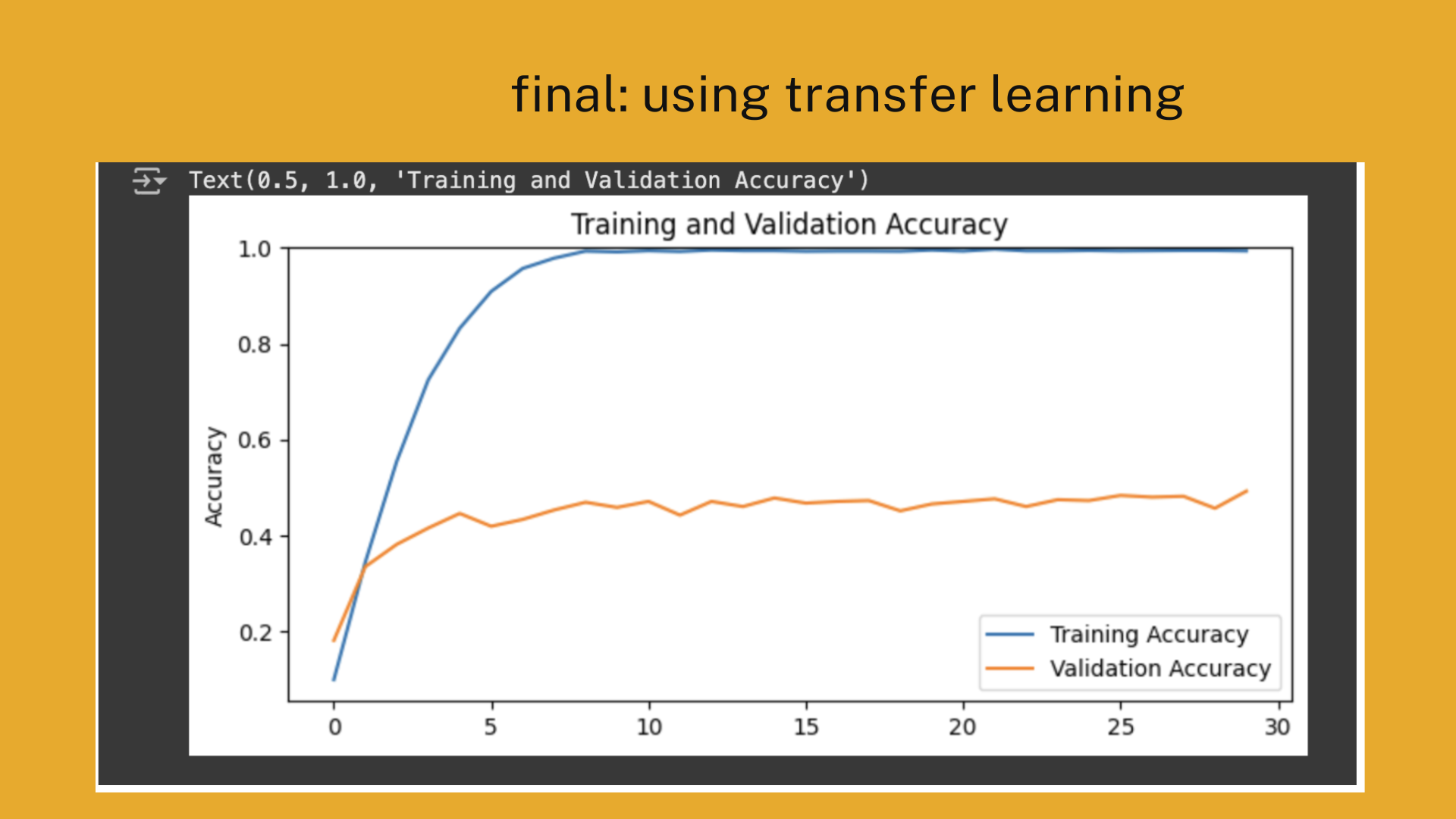
Accuracy Visualization – Plotted training vs. validation accuracy/loss to track model performance.
Model Evaluation – Achieved high accuracy in classifying common Indian dishes (e.g., dosa, biryani, samosa).
Scalable Codebase – Notebook structure allows easy updates or transfer learning with larger datasets.
THE OUTCOME
The model Indian-food-image-classification can now identify popular Indian dishes from images with strong accuracy and serves as a solid base for more advanced applications like calorie estimation, regional tagging, or smart meal logging.
This project shows practical application of:
Deep learning
Data preprocessing
Image augmentation
Model evaluation and visualization